





Why Lumens Per Watt Could Be the Most Important Number in Your Mine
Juni 26 2026
Vision X Tremor Series Work Lights Redefine What "Reliable" Means for Mining Operations
When a haul truck goes down at an open-cut mine, the clock starts immediately. On a large copper or gold operation, a single 400-ton class haul truck can represent $10,000 to $20,000 or more in lost production per hour when it's sitting idle. Factor in the ripple effect across the loader feeding it, the crusher starved of material, and the downstream processing plant running below capacity, and a single unplanned equipment stoppage can cost an operation six figures before a maintenance crew even identifies the fault.
Some mine managers think about lighting as an afterthought — a box-ticking exercise to meet site safety requirements. But what happens when a light fails mid-shift on a Caterpillar 793 haul truck running a 24-hour push, or a Liebherr dragline needs to be walked to a new strip in the middle of the night? The asset has to stop. The crew has to troubleshoot and replace in often punishing conditions. And if that lighting failure triggers a safety hold, the unplanned downtime multiplies.
This is precisely the problem we set out to solve with the new Tremor Series Mining Work Lights — and we've done it by going back to first principles: the science of luminous efficacy.

We have spent over two decades engineering lighting for demanding applications, and the Tremor Series represents the accumulation of that experience applied specifically to the mining context. The engineering philosophy is straightforward: a light that runs cooler lives longer, a light that's properly isolated from vibration stays intact, a light that's precisely aimed does its job, and a light that's over-built from materials rated for harsh environments keeps performing when others have failed.
For fleet managers, site safety officers, and maintenance planners, the Tremor Series offers something genuinely rare in the work light market: a product where the engineering choices are directly traceable to the operating conditions of real mining equipment. The luminous efficacy numbers aren't marketing gloss — they represent a direct reduction in thermal stress on every electrical component in the lamp. The IronPoint™ system isn't just a mounting bracket — it's a vibration isolation and precision aiming platform that makes fleet-wide lighting standardisation achievable. The 5mm stainless brackets aren't just heavy-duty — they're corrosion-resistant, more robust than any lamp on the plant, and built to outlast the lamps they carry.
When a dragline is walking to a new strip at 3am, when a loader is making the last dig before a shift change, when a haul truck is pulling grade on a loaded haul in the dark — the last thing any operation needs is a light failure. The Tremor Series is built around that single, non-negotiable requirement.

The Science of Luminous Efficacy: Why Lumens Per Watt Matters More Than Raw Lumens
Walk into any mining supply catalogue and you'll find work lights competing on raw lumen output. Bigger numbers, bigger claims. But raw lumens is only half the story. The metric that actually predicts how long a light will last — and how reliably it will perform over years of continuous use — is luminous efficacy: the number of lumens delivered per watt of electrical power consumed.
Here's why it matters so much in a mining context:
Heat is the primary enemy of LED longevity. Every watt of electricity that isn't converted into light becomes heat inside the lamp housing. That heat stresses the LED junction, degrades the phosphor coating that gives the light its color temperature, and accelerates failure of the driver electronics. A light that runs hotter ages faster — full stop.
A lamp with high luminous efficacy is converting more of its electrical input into visible light and less into waste heat. This means the LED junction runs at a lower temperature, the thermal management system is under less stress, and the lamp's rated lifespan extends dramatically. In practical terms, higher lumens per watt means fewer lamp changes, less exposure of maintenance personnel to hazardous work areas, and fewer unplanned equipment stoppages.
The Tremor Series Mining Work Lights have a greater luminous efficacy than any other work light available in the market today, with the 48W Tremor 8 LED achieving over 120 lumens per watt — meaning it draws less power, runs cooler, and will last longer than any other lamp with the same light output.
To put that in perspective: a conventional halogen work light of equivalent output might achieve 15–20 lumens per watt. Many LED work lights marketed to the mining sector sit in the 80–100 lm/W range. Breaking 120 lm/W is a meaningful engineering achievement — and in a mining application, it translates directly into extended service intervals and reduced unplanned downtime.

The Thermal Management Advantage
Achieving industry-leading luminous efficacy doesn't happen by accident. The Tremor Series is engineered from the ground up around thermal performance.
Top Bin Cree LEDs are driven at 6 watts for the standard output lamps, or 9 watts for the high output lamps, through a proprietary TIR (Total Internal Reflection) optic designed to focus light where it's needed most, reducing stray light and unwanted glare on the worksite.
The TIR optic approach is significant beyond beam quality. By eliminating the optical losses inherent in conventional reflector designs, TIR optics allow more of the generated light to reach the target surface — which means less power is needed to achieve a given illumination level, which in turn reduces heat generation at the source.
The Tremor heat sync is massive in proportion to the lamp's power draw. This mechanical advantage combined with live thermal management is how we achieve such a high luminous efficacy. Where many competitors spec a heat sink that's adequate for the rated wattage under ideal conditions, the Tremor's oversized heat sync provides a significant thermal buffer — critical when ambient temperatures in an open-cut mine can push 45°C or higher, and when duty cycles are 24 hours per day, seven days per week.
This approach to thermal management is the key link between luminous efficacy and reliability: a cooler-running LED maintains its lumen output over a longer service life, reducing the rate of lumen depreciation and pushing the L70 rating (the point at which the lamp falls to 70% of its initial output) dramatically further into the future.

Built to Survive: The IronPoint™ Anti-Vibration System
The single biggest cause of work light failure in mining applications isn't lumen depreciation or water ingress — it's vibration. Draglines generate continuous structural vibration through their dig-and-swing cycle. Haul trucks transmit enormous shock loads through their frames on every loaded haul, particularly on rough haul roads where G-forces through the chassis can be extreme. Loaders — whether rope shovels or hydraulic excavators — experience significant dynamic loads with every dig cycle.
The Tremor's IronPoint™ Anti-Vibration Mounting System features a polyurethane isolator positioned between the housing and the bracket to fully dampen vibration and fully isolate the lamp from the rigid mounting surface. A composite pointer system further isolates the bolts from the bracket and allows operators to precisely aim the lights in conformance with lab and field tested lighting solutions that can be consistently applied to all the assets in a fleet.
The urethane isolation layer is a genuinely clever piece of engineering. By introducing a compliant layer between the lamp body and the mounting surface, the system breaks the direct transmission path for high-frequency vibration. The polyurethane acts as a mechanical filter, absorbing the energy that would otherwise resonate through the lamp housing and stress solder joints, LED bonds, and driver components. On a haul truck running 60 Grms of vibration exposure — a figure commonly measured on the structures of large mining trucks — this isolation is the difference between a light that lasts months and one that lasts years.
The Tremor Series is rated to withstand 60 Grms of vibration exposure, which aligns with the real-world conditions found on large mining equipment. This is not a spec achieved through software padding — it's the result of the physical isolation system built into every Tremor mount.
The precision aiming capability of the IronPoint™ system addresses a different but equally important problem: fleet standardisation. On a large haul truck fleet, achieving consistent lighting coverage from machine to machine matters for both safety and productivity. Operators moving between trucks need consistent visibility. Lighting solutions need to meet site-specific photometric plans. The composite pointer system allows operators to precisely aim lights in conformance with lab and field tested lighting solutions that can be consistently applied across all assets in the fleet. This is a significant advantage for fleet managers who need to implement and document a standardised lighting specification across dozens of assets.

The Tremor Series Line-Up: Matching the Light to the Application
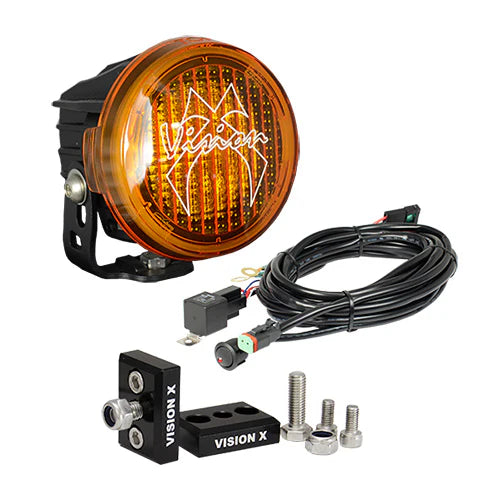
The Tremor Series Work Lights are available in 3, 5, and 8 LED configurations with beam patterns of 25 and 40 degrees, making them ideal for a wide range of applications. We has also added an Anti-Glare elliptical flood beam to the line-up — a critical option for operations where oncoming traffic, operators in adjacent equipment, or ground crew could be dazzled by conventional beam patterns.
The 5 LED and 8 LED lamps are available in high-watt and low-watt versions, a specific request from asset managers and operators who needed different output and power draw options to suit different mining applications. The 5 LED lamp was specifically engineered to create the ideal headlight upgrade kit for popular haul truck models when combined with vehicle-specific brackets.
This matters because haul trucks — particularly Komatsu 730E, 830E, and 930E models common across large coal and hard rock operations — often run with factory halogen headlights that represent a significant downgrade from what modern LED technology can deliver. The Tremor 5 LED with vehicle-specific brackets provides a direct-fit upgrade path that gives these trucks the safety and reliability benefits of the Tremor platform without custom fabrication.
The full Tremor 8 LED, available in both 48W and 72W configurations, is the natural choice for high-demand positions: dragline boom tips, loader work lights, and the rear-facing lights on haul trucks operating in tight tip-head situations. The 48W Tremor 8 LED produces 6,190 raw lumens in spot and flood configurations, while the 72W version steps up to 9,650 raw lumens — both operating across 11–33 VDC to accommodate the voltage variation common in large mining electrical systems.
The Selective Yellow option available in the 5 LED configuration addresses a specific challenge in dusty or high-particulate environments. Yellow-spectrum light (typically around 580–600nm) scatters less in dust and water droplets than white light, improving effective visibility at the working face during blast clearing operations or in dusty conditions common to coal and aggregate operations.
All Tremor Series lights carry IP68 and IP69K ratings, meaning they are fully submersible and can withstand high-pressure, high-temperature washdown — essential for equipment that goes through pressure washing during scheduled servicing.
0 Kommentare